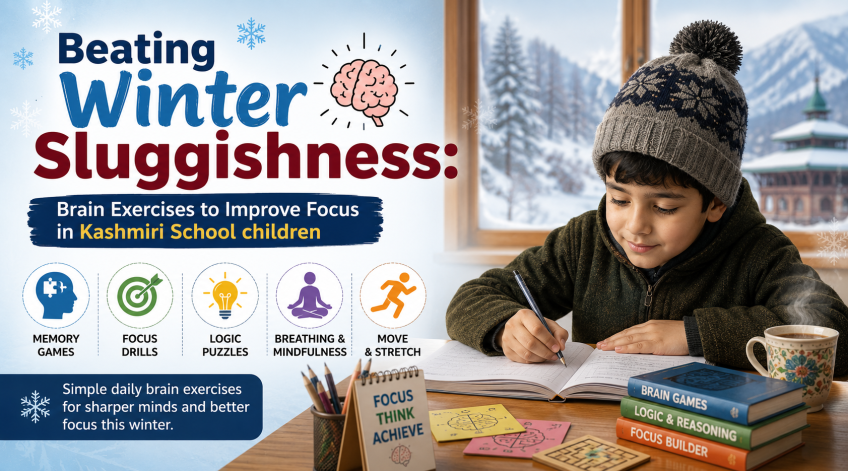
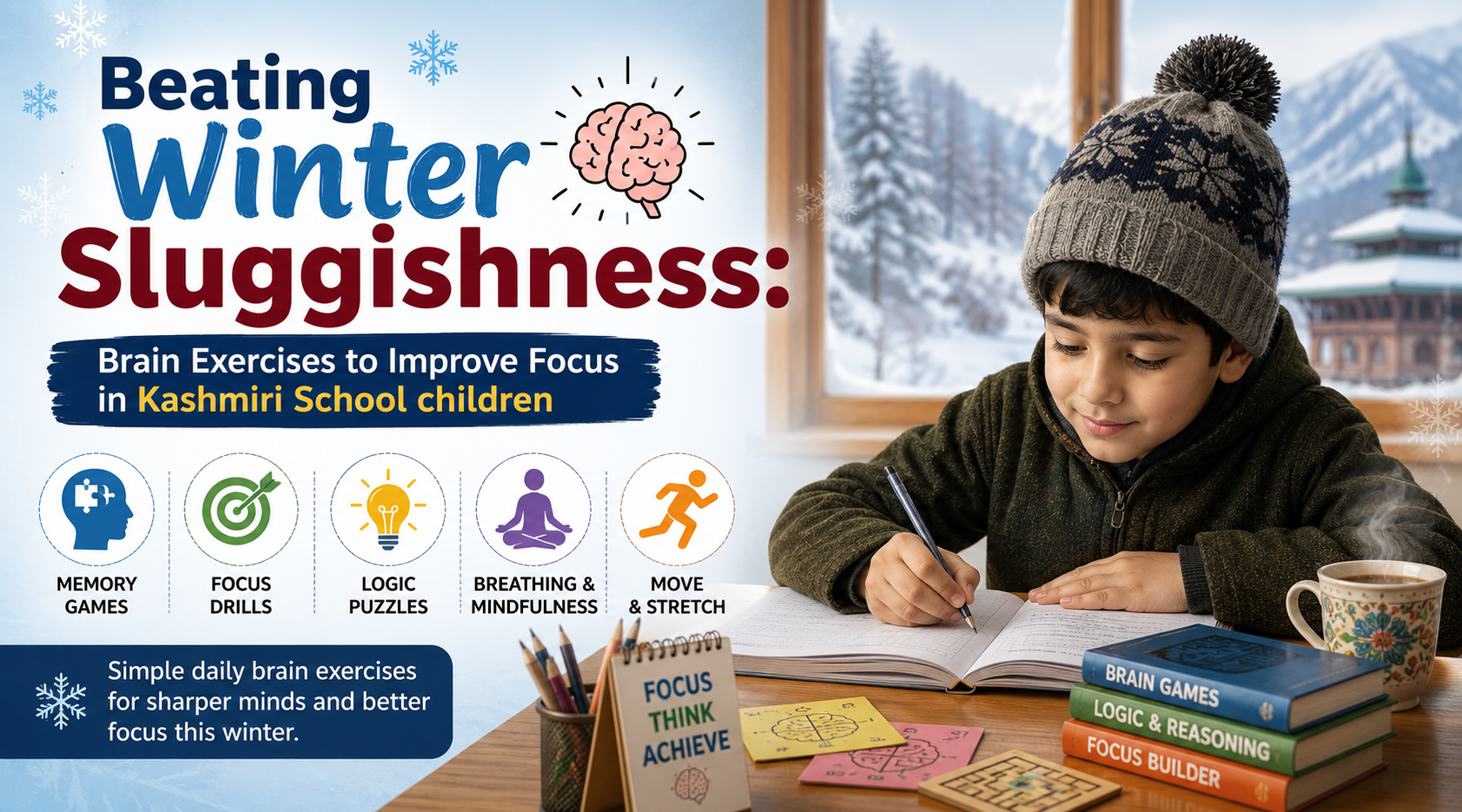
Life in the Kashmir Valley moves to its own unique rhythm. While our rich culture and geographical landscape are unmatched, the region presents unique environmental challenges for growing children. The harsh, freezing winters often mean long, continuous months spent indoors with restricted outdoor physical play.
With limited physical outlets during these periods, many parents in Srinagar, Anantnag, and Baramulla face a common challenge: children are turning to smartphones for entertainment.
This extended indoor screen-time creates cognitive sluggishness. Parents frequently notice that when schools reopen or examinations approach, children struggle to concentrate on text-heavy books, experience brain fatigue quickly, and struggle to retain complex concepts.
To combat this indoor-induced attention drop, parents can introduce specific, targeted brain exercises that improve focus, keeping young minds active, agile, and sharp throughout the year.
- The Photographic Memory Flashcard Test
When a child spends hours looking at moving video screens, their brain becomes a passive consumer of information rather than an active observer. To reverse this, we must activate their photographic memory.
- The Exercise: Take a highly detailed picture, a historical map, or a complex array of objects. Let your child look at it for exactly 10 seconds. Cover the image and ask them specific, minute questions (e.g., “What color was the coat of the person on the left?” or “How many windows were on the house?”). This builds visual attention and trains the brain to take rapid mental snapshots of physical data.
- Mentally “Seeing” the Math: Spatial Visualization
When children learn math abstractly through rote memorization, it causes cognitive fatigue. Giving them a physical, visual mental anchor completely changes how their brain processes data.
- The Exercise: Have your child mentally map out paths or structures. In advanced settings, this is done by training the child to look at a calculation tool, memorize the bead patterns, and then mentally slide those beads with their eyes closed to solve intricate mathematical equations. This acts as a high-intensity workout for the right hemisphere of the brain, responsible for creativity, visualization, and deep concentration.
- Deep Listening & Reverse Sequencing
To build cognitive resilience, children must learn to hold pieces of information in their short-term working memory while processing new data.
- The Exercise: Say a sequence of 5 words or numbers to your child (e.g., Apple, Chinar, River, Snow, Kangri). Ask them to repeat the sequence completely in reverse (Kangri, Snow, River, Chinar, Apple). This simple exercise demands absolute focus; a single second of distraction will break the sequence.
Keeping Young Minds Bright Across Kashmir with Aloha
Brain development shouldn’t stop when outdoor activities freeze. Aloha J&K’s scientifically designed skill development programs act as a year-round, indoor mental gym for children aged 4 to 13.
By using the Abacus as a core structural tool, Aloha transforms abstract numbers into a tangible, playful learning system. Our students develop an incredible capacity for speed, precision, and analytical thinking. The exercises practiced in an Aloha classroom don’t just eliminate math phobia—they systematically expand a child’s attention span, listening skills, and self-confidence, ensuring they excel in every school subject.