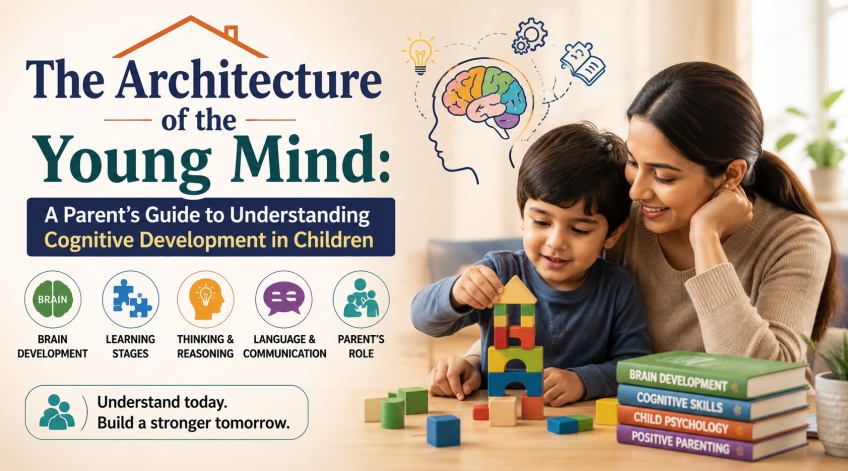
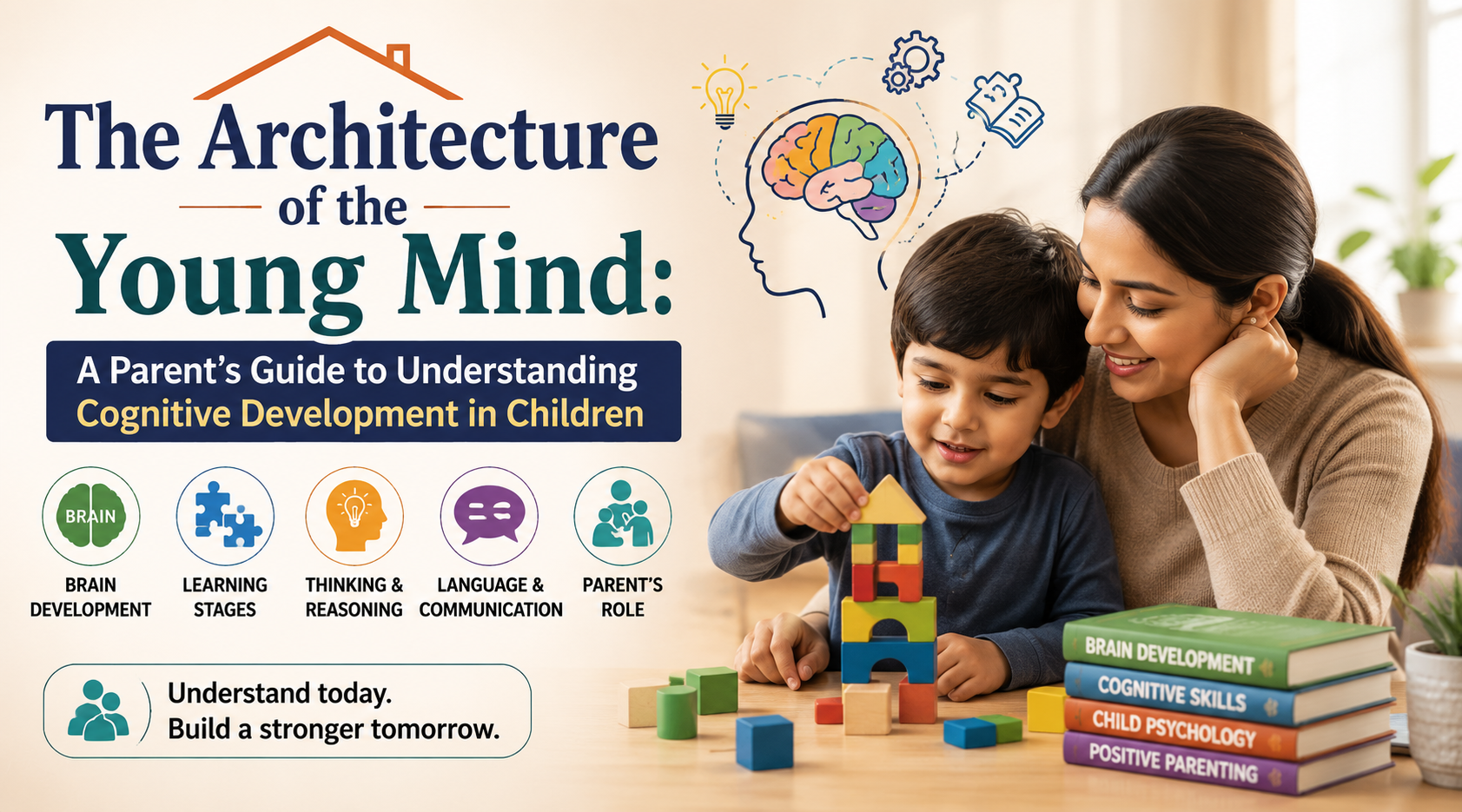
Every time a child learns a new word, successfully ties their shoelaces, solves a puzzle, or manages their frustration when losing a game, their brain is undergoing a complex architectural transformation. For decades, parents measured growth primarily by physical milestones—height, weight, and motor skills. However, in the modern educational landscape, the focus has shifted deeply inward.
Understanding cognitive development in children is no longer just a subject for academic psychologists; it is the ultimate blueprint for parents who want to help their children build the mental resilience, focus, and intelligence required to thrive in a rapidly evolving world.
Cognitive development refers to how a child perceives, thinks, and gains an understanding of their world through the interaction of genetic and learned factors. It encompasses areas such as information processing, intelligence, reasoning, memory, language development, and crucial “executive functions” like decision-making and self-control.
To help your child unlock their true intellectual potential, let’s unpack how the brain develops, the specific milestones to look out for, and how you can actively stimulate whole-brain growth.
The Cognitive Blueprint: How a Child’s Brain Grows
The human brain grows at an astonishing rate early in life. By the age of five, a child’s brain has already reached roughly 90% of its adult size. During these foundational years, the brain forms millions of synapses—the connections that allow neurons to communicate with one another.
As children grow, their brains undergo a natural process called synaptic pruning. Connections that are used frequently become stronger and more permanent, while connections that are neglected fade away. This means that the environments, activities, and mental exercises a child is exposed to between the ages of 4 and 13 directly sculpt the literal physical structure of their adult brain.
Left Brain vs. Right Brain: The Need for Equilibrium
True cognitive mastery requires structural harmony between the two hemispheres of the brain:
- The Left Hemisphere: This side is primarily analytical, logical, sequential, and text-oriented. It handles step-by-step processing, such as reading a sentence, memorizing facts, and executing traditional linear mathematics.
- The Right Hemisphere: This side is intuitive, creative, spatial, and visual. It processes information globally, recognizes faces, visualizes abstract concepts, and governs emotional understanding.
The traditional schooling system often heavily favors left-brain education—focusing on rote memorization, repetitive writing, and theoretical text reading. However, when a child’s education lacks right-brain stimulation, they struggle with higher-order cognitive skills like creative problem-solving, rapid spatial estimation, and innovative thinking.
Maximizing cognitive development requires Whole Brain Development—engaging both hemispheres simultaneously.
Critical Milestones in Cognitive Development (Ages 4 to 13)
Cognitive growth doesn’t happen in a uniform, straight line. Instead, it occurs in distinct, predictable stages. Understanding these stages allows parents to provide the right mental stimulation at the exact moment their child’s brain is ready to receive it.
Phase 1: The Intuitive & Preoperational Stage (Ages 4 to 7)
At this stage, children learn primarily through imitation, play, and symbols. They are highly imaginative, but their thinking is still largely egocentric (they struggle to see things from another person’s point of view) and concrete.
- Key Milestones: Developing symbolic thought (using an object to represent something else), rapid language acquisition, and basic classification skills (sorting blocks by color or size).
- The Challenge: Attention spans are naturally brief, and logical reasoning is fluid rather than absolute. Children at this stage easily experience cognitive fatigue if forced into rigid, hours-long study routines.
Phase 2: The Concrete Operational Stage (Ages 7 to 11)
This is a massive turning point in a child’s cognitive development. Thinking becomes far more logical, organized, and structured. Children begin to understand the concept of conservation—the realization that an amount stays the same even if its shape or container changes.
- Key Milestones: The ability to perform mental operations (such as reverse arithmetic), understanding cause-and-effect relationships, and significantly improved operational memory.
- The Challenge: While they can think incredibly logically, their reasoning is still heavily tied to physical, concrete realities. Abstract concepts—like advanced algebraic variables or theoretical formulas—can cause intense frustration and anxiety if not introduced using visual or tactile methods.
Phase 3: The Early Formal Operational Stage (Ages 11 to 13)
As children enter early adolescence, their brains begin to master abstract reasoning. They no longer need a physical object in front of them to solve a problem; they can formulate hypotheses, think systematically about the future, and engage in metacognition (thinking about their own thinking).
- Key Milestones: Abstract problem-solving, systematic planning, and the development of conceptual strategies.
- The Challenge: This stage coincides with a massive neurological rewiring during puberty. Executive functions can become temporarily erratic, making structured, calming mental routines absolutely essential to keep them grounded.
The Pillars of Executive Function: The Brain’s Control Center
Beyond academic scores, understanding cognitive development means tracking a child’s Executive Functions. Think of executive function as the air traffic control system of the brain—it manages the flow of information, filters distractions, and dictates focus.
- Working Memory: The capacity to hold and manipulate pieces of information in the mind over short periods. A strong working memory allows a child to remember multi-step instructions without getting lost along the way.
- Cognitive Flexibility (Mental Shift): The ability to switch gears, adapt to unexpected changes, and look at a problem from multiple different angles when the first approach fails.
- Inhibitory Control (Impulse Management): The vital capability to resist strong inclinations, filter out distracting background noises, and choose focus over immediate gratification.
How to Actively Optimize Your Child’s Cognitive Growth
Cognitive capacity is not a fixed, unchangeable number. It is an evolving asset. By introducing targeted exercises, parents can systematically expand their child’s working memory, accelerate processing speeds, and build lifelong academic confidence.
- Replace Abstract Math with Visual Systems
Mathematics is often the biggest trigger for childhood academic stress because it forces young minds to manipulate abstract symbols before their concrete brain operational phases are fully prepared.
- The Strategy: Use visual tools like the Abacus to represent numbers as physical, moving beads. This bridges the gap between concrete and abstract thinking, transforming complex math into a tactile, visual reality that eliminates anxiety and builds geometric intuition.
- Practice High-Speed Auditory Tracking
To strengthen inhibitory control and working memory, train your child to process audio information at varying speeds without visual aids.
- The Strategy: Read out strings of data or operational instructions rapidly. Force the brain to listen intently, hold those numbers in the working memory, compute the answer internally, and deliver it aloud. This cuts out ambient environmental distractions and sharpens auditory focus.
- Encourage Spatial Mental Mapping
Before a child solves a problem on paper, challenge them to build a complete mental map of the solution in their mind’s eye.
- The Strategy: Have your child close their eyes and manipulate shapes, count objects, or visualize mathematical movements entirely in imagination. This high-level sensory training actively exercises the right hemisphere, paving the way for advanced photographic memory retention.
The Aloha Methodology: Engineering Balanced Minds
At Aloha J&K, our global curriculum is built explicitly around the science of understanding cognitive development in children. We don’t view mental arithmetic as a tool just to pass school tests; we view it as a comprehensive developmental catalyst for the entire brain.
Through our structured, interactive Abacus and Mental Arithmetic courses, we guide children systematically through their vital cognitive phases.
By teaching students to visualize the abacus beads internally, we stimulate the creative right brain while simultaneously engaging the analytical left brain to process the logical numerical data. This dual-hemisphere engagement forces the brain to build richer, denser neural networks.
The result? Aloha students don’t just calculate faster than a computer—they develop significantly higher concentration levels, superior photographic memory, sharp auditory processing, and an unshakeable sense of self-confidence that benefits them across all academic disciplines.
Invest in your child’s neural architecture during their most critical formative years.