Many parents believe that a child’s ability to concentrate is an innate trait—either they are born with a laser-focused mind, or they are naturally easily distracted. Cognitive science, however, tells a completely different story. Focus is a developed skill, highly dependent on daily environmental cues, physical routines, and neural conditioning.
In an era dominated by rapid-fire notifications, algorithmic video feeds, and high-pressure academic schedules, a child’s attention span is constantly under siege. Expecting a child to sit down and focus for hours on end without training their focus “muscle” during the rest of the day is like expecting someone to run a marathon without training.
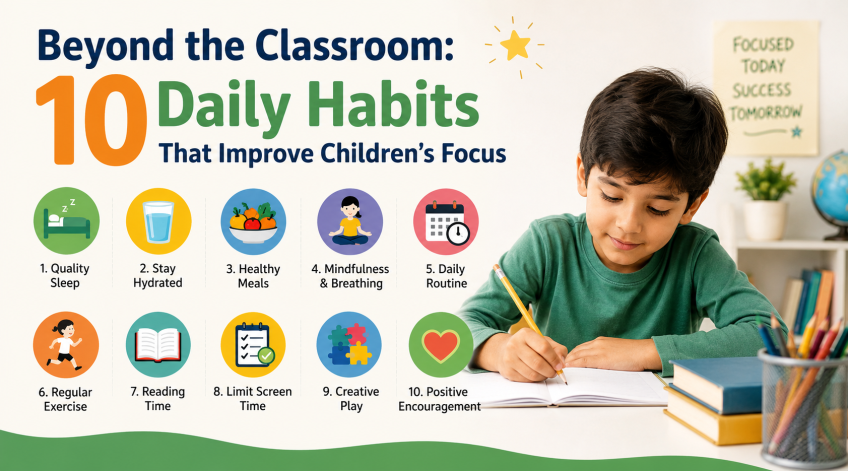
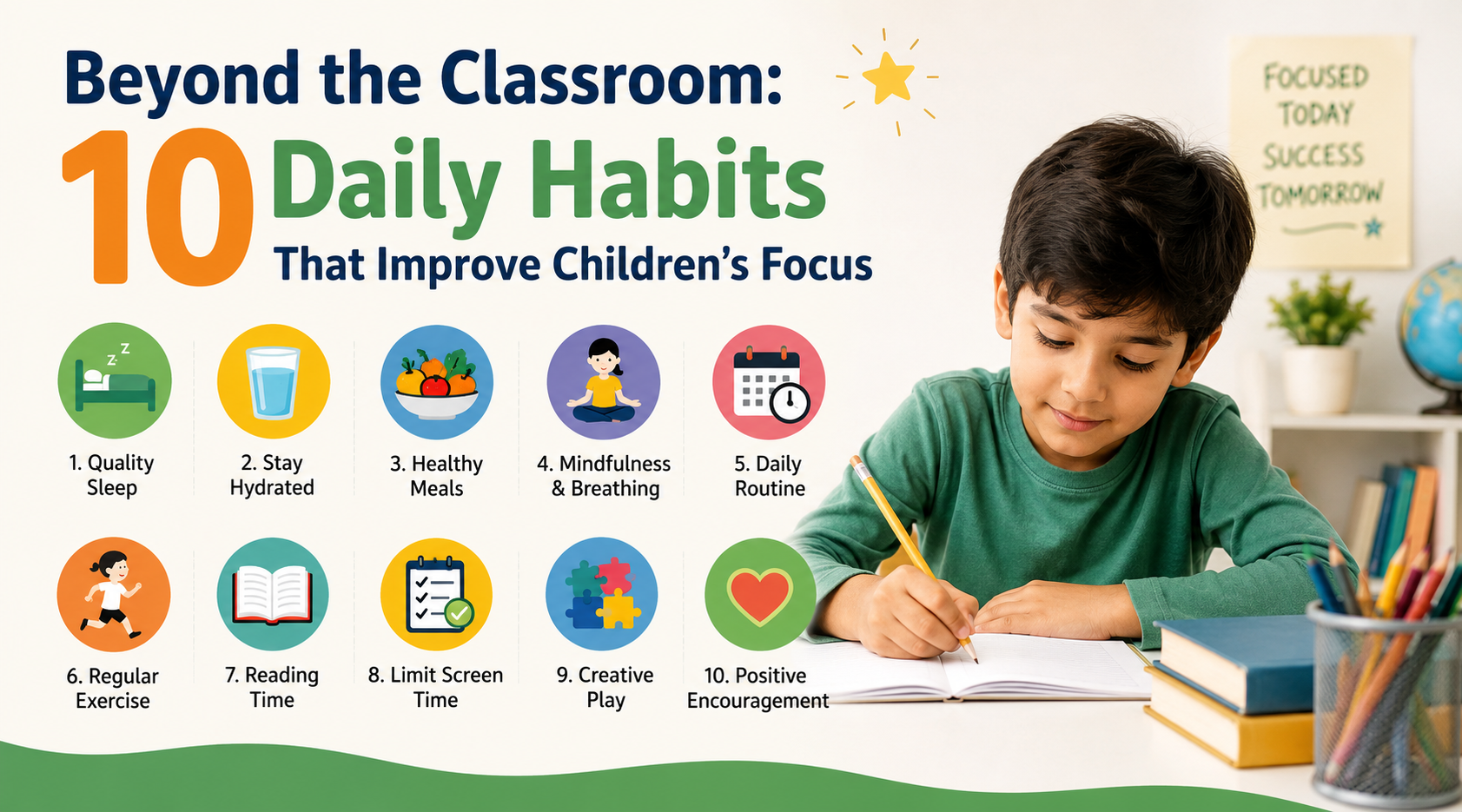
To build an unshakeable attention span, focus must be woven into the fabric of everyday life. Here are 10 powerful, data-backed daily habits that improve children’s focus and unlock their true cognitive potential.
- The “Single-Tasking” Rule for Homework
In a digital world, multitasking has become a modern epidemic. Children frequently try to solve math problems while glancing at a tablet, listening to background music, or chatting with a family member. Multitasking doesn’t save time; instead, it causes “cognitive switching penalties,” draining the brain’s energy and fracturing the attention span.
- The Habit: Establish a strict single-tasking rule during study hours. Clear the workspace of all non-essential items. If they are working on a reading assignment, that is the only thing allowed on their desk. This trains the neural pathways to sustain deep focus on a single stimulus at a time.
- Implementing the “20-20-20” Digital Eye Strain Rule
Extended screen time physically fatigues the ciliary muscles of the eye, which sends distress signals to the brain, causing cognitive fatigue and a drop in concentration.
- The Habit: For every 20 minutes your child spends looking at a digital screen (for school or leisure), have them look away at an object at least 20 feet away for at least 20 seconds. This simple physical reset reduces optical fatigue and preserves mental stamina for reading and writing tasks.
- A Consistent “Dopamine Fast” Before Bedtime
The high-contrast blue light emitted by smartphones and televisions suppresses the natural production of melatonin, the hormone responsible for deep sleep. More importantly, the rapid reward loops of video games and short-form videos overstimulate dopamine receptors, making standard schoolbooks feel painfully boring the next morning.
- The Habit: Implement a firm digital blackout at least 60 minutes before bedtime. Replace screens with physical books, audiobooks, or a calming conversation. A well-rested, chemically balanced brain is dramatically better at focusing the following day.
- The Morning “High-Protein, Steady-Glucose” Breakfast
What your child eats for breakfast directly dictates their cognitive curve for the rest of the afternoon. High-sugar cereals, white bread, and refined pastries cause a rapid spike in blood glucose, followed by a sharp mid-day crash that leaves children irritable, hyperactive, or daydreaming at their desks.
- The Habit: Build breakfast around lean, high-quality proteins and complex carbohydrates (such as eggs, oats, and nuts). Protein stabilizes blood sugar levels, providing a steady, reliable stream of amino acids to help the brain synthesize focus-regulating neurotransmitters.
- Mindful “Transitions” Between Activities
Moving immediately from a high-energy environment (like playing a sport or returning home from a noisy school bus ride) to a high-concentration task (like studying) creates mental friction. The child’s nervous system is still revved up, leading to restlessness.
- The Habit: Create a 5-to-10-minute “buffer zone” between major daily events. Have your child wash their face, practice a brief breathing exercise, or simply sit quietly for a few minutes before opening their books. This signals the nervous system to shift from a high-energy state into an analytical, focused state.
- The “Brain Dump” Journaling Routine
When a child sits down to study, their working memory is often cluttered with unresolved thoughts: a disagreement with a friend, anxiety about an upcoming test, or excitement about a weekend plan. This internal monologue continuously saps their executive function.
- The Habit: Give your child a blank notebook and 3 minutes to scribble down every single thought, worry, or task currently floating in their head before they start studying. Physically clearing these thoughts onto paper frees up valuable cognitive real estate for learning.
- Structured “Brain Breaks” Using the Pomodoro Method
Forcing a young child to sit still for two hours straight is counterproductive. Attention spans have natural limits, and forcing a exhausted brain to study results in passive reading and high error rates.
- The Habit: Use a modified Pomodoro technique tailored to your child’s age. For younger children (ages 5-8), aim for 15-20 minutes of intense focus followed by a 3-minute break. For older children, try 25 minutes of work followed by a 5-minute break. During the break, they must stand up, stretch, or move physically—no looking at screens allowed.
- The Daily 10-Minute Spatial Visualization Drill
A powerful way to expand a child’s attention span is to challenge their mental tracking abilities through visualization, forcing the left and right hemispheres to coordinate.
- The Habit: Spend 10 minutes a day playing memory games, solving physical puzzles, or practicing abstract visual math. Exercises where a child has to close their eyes and manipulate objects mentally build a profound capacity for deep, independent concentration.
- A Dedicated “Distraction-Free” Zone
Our physical environment shapes our psychological habits. If a child studies in bed, their brain confuses relaxation with work. If they study at the dining table amidst family chatter, their auditory cortex is constantly overworked trying to filter out the noise.
- The Habit: Set up a dedicated study corner that is used exclusively for focused work. Keep it well-lit, quiet, and consistently organized. Over time, simply sitting down in this specific chair will act as a psychological trigger, automatically priming the brain to enter focus mode.
- The Evening “Win” Reflection
Children who struggle with focus often face persistent negative feedback throughout the day (“Stop moving,” “Pay attention,” “Why haven’t you finished this?”). This builds academic anxiety, making them want to avoid cognitive tasks altogether.
- The Habit: Every night at dinner or right before bed, ask your child to share one small thing they successfully focused on or achieved that day. Celebrating these micro-wins rewires their relationship with effort, reinforcing the idea that deep concentration is a rewarding and achievable skill.
The Ultimate Habit: The Aloha Mental Gym
While forming these habits at home is incredibly beneficial, true cognitive transformation happens when daily habits are paired with a structured, scientific training regimen.
At Aloha J&K, we have designed our global Abacus and Mental Arithmetic program to serve as the ultimate daily workout for a child’s attention span. By practicing our visualization and rapid-calculation techniques for just a few minutes every day, Aloha students build incredible mental stamina.
The daily habit of manipulating abstract numbers via a mental abacus expands working memory, sharpens auditory listening skills, and teaches children how to block out background distractions with absolute ease